Dr.'s Blog
Is Chiropractic Safe? What the Newest Research Says About Neck Adjustments, Stroke & Risk
November 11, 2026
Is Chiropractic Safe? What the Newest Research Says About Neck Adjustments, Stroke & Risk
In this article:
- The concern is real, but VERY rare
- The coincidence problem nobody explains
- What the largest studies show
- Does an adjustment even stretch the artery?
- Nearly one million adjustments: the real-world data
- “Manipulation” isn’t the same thing as a chiropractic adjustment
- The safest chiropractor knows when NOT to adjust
- “But my doctor said not to because of my arthritis…”
- What malpractice insurers know
- The other side of the ledger
- What this means for you
- FAQ
“Don’t let a chiropractor touch your neck. My cousin heard that their sister’s friend had a stroke.”
If you’ve heard some version of that from a family member, a TikTok video, or even your own doctor, you’re not alone. Believe me… I’ve heard it too! It’s almost people think we are trained like ninjas and are a part of some movie…
Honestly… I love addressing this, as it’s easy to clear up. From the outside looking in, or moreso when listening to others… I could get where someone would get the idea. As, unfortunate as it is. But, when it comes to your health, you SHOULD ask the hard questions! You should ask it about every single thing anyone does to your body: adjustments, medications, injections, surgery. All of it.
The problem is… FEAR sells. Just watch the news for 10 minutes. Oldest trick in the book. Most people only hear one side of the story, usually secondhand, and usually missing the details that matter most. Sure, we help people every single day with issues that get them back to living life to the fullest. Off meds. Cancelled surgeries. Back to working out, playing with kids, playing golf, etc. But… that’s not the info that medical docs like relay! Nope. No fun.
So let’s lay it all out. What the concern is, where it came from, what the largest studies show (including two published in just the last two weeks), and what the risks look like when you take the “conventional” route instead.
A little context on where I’m coming from. I’ve been getting adjusted since before I was 20, through collegiate hockey and years of competitive CrossFit. I’m a dad, so this question matters to me for my own family, not just my patients. Nothing in healthcare is technically zero risk… but chiropractic is certainly on the safest side of things out there. I am going to show you why the scary version you’ve heard leaves out most of the picture.
At the end of the day, the health and well-being of my patients is my absolute top priority. It’s what I live for day in, and day out. I would NEVER put a patient of mine in harms-way. Although there are certain unknowns… we do take every precaution to make sure our patients are getting the best care!

Diving Right into the Big Question
The fear centers on something called cervical artery dissection (CeAD): a small tear in the inner wall of one of the arteries in your neck, either a vertebral artery or a carotid artery. Blood can collect in the vessel wall, a clot can form, and in some cases that leads to a stroke.
This is a real condition, and of course I take it seriously. Cervical artery dissection accounts for about 2% of all ischemic strokes, but up to 25% of ischemic strokes in adults under 50. That’s exactly why it gets so much attention. heart
It’s also genuinely rare. In the general population, incidence has been estimated at about 4.7 per 100,000 person-years (2002–2020), rising from 2.3 in the earliest period to 8.9 in 2017–2020. That study came out of Mayo Clinic’s population data here in Minnesota, and the researchers attributed much of that rise to more vascular imaging being done, not a true explosion of cases. Only about 56% of dissections ever result in a stroke at all. springerspringer
The most important thing to understand is that the vast majority of these dissections happen with nobody touching the person’s neck. They can occur without any major trauma, and they’re more strongly linked to younger age, migraines, and minor trauma than to the traditional cardiovascular risk factors behind most strokes. heartspringer
The Coincidence Problem
This is the single most important concept in this whole article, and almost nobody talks about it.
What are two of the most common early symptoms of a cervical artery dissection? Neck pain and headache. Dizziness and tinnitus can show up too, and because the symptoms are so nonspecific, diagnosis is difficult. heart
Now, what are two of the most common reasons people walk into a chiropractor’s office? Neck pain and headache. Numbness, tingling… you get the picture.
Picture this timeline:
→ Monday: A dissection starts forming. It produces an unusual neck ache and a headache.
→ Tuesday: The person books a chiropractic visit, because that’s what you do when your neck hurts.
→ Thursday: They have a stroke.
The story everyone tells afterward is “chiropractor → stroke.” But the biological story may have been “dissection → neck pain → chiropractic visit → stroke.” Same events, completely different cause.
Researchers call this protopathic bias. The early symptom of a disease causes someone to seek treatment, and then the treatment gets blamed for the disease. The timing makes it even harder to untangle: stroke after a dissection has occurred anywhere from a few minutes to 31 days after symptoms begin, with 82% happening in the first week. That’s the exact window when someone with a brand-new, weird neck pain is most likely to be sitting in someone’s office. Mine, their family doctor’s, urgent care, a massage therapist’s. heart
And medical offices miss these too. The 2026 study I’ll cover next deliberately excluded people with recent emergency visits because dissection may be missed among people with neck pain or headache. That isn’t a knock on ER doctors. It’s how hard this condition is to catch in its early stages, for every profession. springer
What the Largest Studies Show
818 strokes and more than 100 million person-years of data
Back in 2008, researchers studied every hospitalized vertebrobasilar stroke in Ontario over nine years. There were 818 such strokes in a population representing more than 100 million person-years. In people under 45, those who had a stroke were about three times more likely to have seen a chiropractor beforehand, AND about three times more likely to have seen their primary care doctor too. nih
Read that again. BOTH. Primary care visits were linked with later stroke in every age group, there was no increased association with chiropractic visits in people over 45, and visits billed for headache or neck complaints were strongly tied to a subsequent stroke. nih
If chiropractic adjustments were tearing arteries, you wouldn’t expect the family doctor, who isn’t adjusting anyone’s neck, to show the same pattern. What does explain both is people seeking help for the early symptoms of a dissection already in progress. For fairness: some skeptics argue this study still can’t completely rule out a small added risk, and that’s a reasonable scientific point. But it changed how serious researchers frame the question.
862,984 patients: the new September 2026 study
This is the big one, and it just published. Researchers used linked U.S. health records and insurance claims from 2010–2025 and did something clever to deal with the coincidence problem. They only looked at adults who had just developed new neck pain or headache, and compared two groups dealing with the same symptoms: people who got a chiropractic neck adjustment, and people who went to a medical visit and were prescribed ibuprofen. They excluded anyone with previous stroke or dissection, used propensity matching to balance the groups, and ended up with 431,492 patients in each group. springer
The results: within 30 days, 31 people in the chiropractic group (0.007%) and 58 in the ibuprofen group (0.013%) were diagnosed with a dissection. The chiropractic group had averaged about 3.6 adjustment visits over the month, roughly 1.55 million visits total. springerspringer
Just being real, I want to be careful here, because the authors were. This does NOT mean adjustments prevent dissections. The researchers said any apparent reduction was small and likely due to residual confounding, and that their findings fit a “no increased risk” interpretation rather than a “chiropractic is better” one. One reason for the gap is actually a good thing: chiropractors may selectively avoid neck adjustments in patients they perceive as higher-risk based on exam findings or family history. Screening at work, more on that below. springerspringer
The most fascinating finding: dissection incidence was 7 to 13 per 100,000 over those 30 days, rising sharply in the first two weeks, regardless of which treatment people got. The authors concluded that adults presenting with new neck pain or headache may have a temporarily elevated risk of dissection no matter what care they receive. springer
Put that next to the general-population rate above, which is measured per year. This is a rough, back-of-the-napkin comparison, not something the authors calculated, and the populations aren’t identical. Even so, the one-month rate among people with brand-new neck pain or headache looks roughly ten times higher (or more) than the general population’s monthly rate. The patients walking through the door with new neck pain were already at higher risk before anyone treated them.
Older adults and U.S. adults
This isn’t a one-off finding. Two large U.S. claims studies, one in Medicare patients and one in U.S. adults, used both case-crossover and case-control methods in patients with neck pain or headache and found no significant association between spinal manipulation and dissection. (Whedon et al., BMC Geriatrics 2022; Whedon et al., European Spine Journal 2023) springer
The brand-new meta-analysis (published September 23, 2026)
A meta-analysis pools every eligible study together, and a new one from a Duke-led team just came out. I’m including it even though it’s more mixed, because you deserve the whole picture.
They included 10 studies, mostly case-control designs. At their primary one-day window there was no significant association (OR 1.12), and the seven-day window didn’t reach their significance threshold either. Longer windows showed small positive associations, including a statistically significant one at 30 days, but the certainty of that evidence was rated low to very low because the studies varied so much. springer
My read, and this is interpretation, not something the authors stated: the one-day window is where a direct mechanical injury from an adjustment would show up most clearly, and that’s the window with the highest certainty and no association. The longer windows are where the coincidence problem has the most room to operate. The authors themselves concluded there is no definitive evidence of a meaningful association, and that future studies need better control over protopathic bias because patients may present to chiropractors or other clinicians with early symptoms. springer
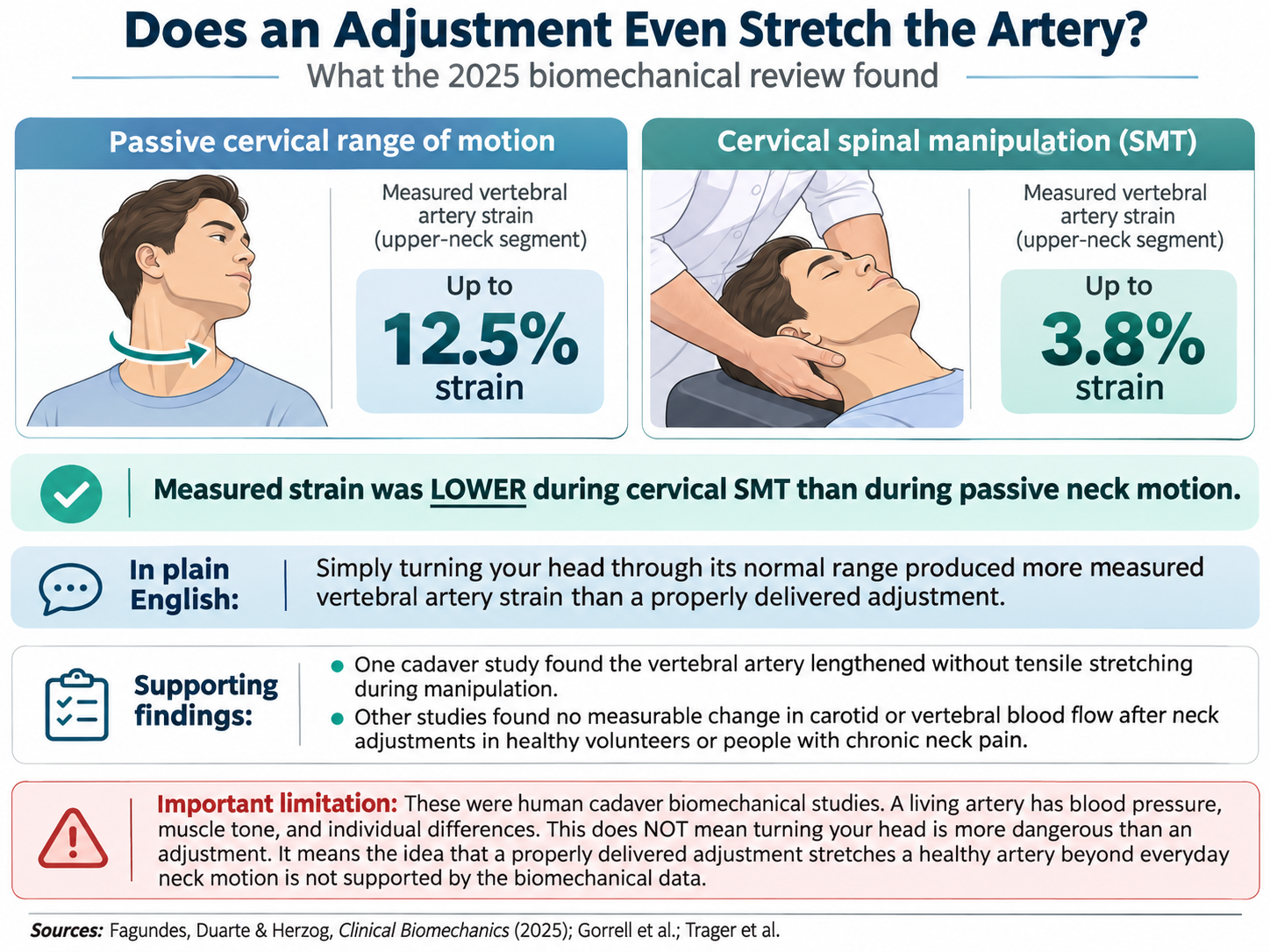
Does an Adjustment Even Stretch the Artery?
The long-standing assumption goes like this: a quick neck adjustment stretches the vertebral artery enough to tear it. Sounds intuitive. So researchers measured it.
A 2025 systematic review and meta-analysis pooled the cadaver studies that measured strain on the vertebral artery. Adjustments consistently produced lower strain (up to 3.8%) than passive range of motion (up to 12.5%) in the upper-neck segment of the artery, with rotation producing notably more strain than the adjustment. (Fagundes, Duarte & Herzog, Clinical Biomechanics, 2025) Read by QxMD
In plain English: simply turning your head through its normal range put more measured strain on the artery than a properly delivered adjustment did.
Other work lines up with this. One cadaver study found the vertebral artery lengthens without being stretched during an adjustment, and other studies found no changes in carotid or vertebral blood flow after neck adjustments in healthy volunteers or people with chronic neck pain. springer
The honest limitation: these measurements come from human cadaver specimens. A living artery has blood pressure, muscle tone, and individual differences. So the correct conclusion isn’t “turning your head is more dangerous than an adjustment.” It’s this: the idea that a properly delivered adjustment stretches a healthy artery beyond what your neck experiences every day isn’t supported by the biomechanical data. PubMed
Nearly One Million Adjustments: The Real-World Data
A 2023 study tracked adverse events across 30 chiropractic clinics over more than five years. Across 960,140 adjustment sessions for 54,846 patients, 39 adverse events were identified. Two were severe, both rib fractures in women over 60 with osteoporosis. None were life-threatening, and there were no events related to stroke or cauda equina syndrome. That works out to 0.21 severe events per 100,000 sessions. (Chu et al., Scientific Reports, 2023) nih
That’s about two severe events per million treatments. A study this size still can’t pin down the rate of an ultra-rare event, and it came from a single clinic network, but it’s meaningful real-world context. Notice what those two severe events were, too. I’ll come back to that in the osteoporosis section.
Randomized trials tell a similar story. A 2023 review of 154 randomized trials found spinal manipulation was delivered to 7,518 participants, with no serious adverse events reported in any of them. The fair caveat: only 94 of those trials actually reported on adverse events, and 7,500 people is nowhere near enough to measure something that might happen once in millions of treatments. RCTs are great for telling us about common side effects, which are mostly mild, temporary soreness. They can’t settle the ultra-rare question alone. That’s why the large population studies above matter so much. chirochiro

Nervous about getting adjusted? Let’s chat first. At our office, your first visit is a consultation, functional assessment, and digital X-rays. We don’t adjust you on day one. We analyze your X-rays first, and your first adjustment happens on a separate visit once we know exactly what we’re working with. Schedule your consultation here or call my direct line at (612) 470-9210 with any questions.
“Manipulation” Isn’t the Same Thing as a Chiropractic Adjustment
When you read “stroke after neck manipulation” in a headline, you probably picture a chiropractor. But in the medical literature, “cervical manipulation” is an umbrella term covering procedures done by many professions, and sometimes by people doing it to themselves.
A 2025 systematic review collected every serious adverse event it could find after conservative neck treatments: 233 publications describing 334 cases. About 75% followed manipulation, but the rest followed massage, acupuncture, mobilization, and more. Chiropractors were the most common provider at 54%, while 46% involved other professions, non-clinicians, or self-administered treatment. Some events even followed vestibular testing, gentle mobilization, exercise, or massage. ScienceDirectScienceDirect
This does confound things a bit, as, we all go through very different training. Some of these professions wouldn’t technically do any actual training specific to the spine. Others might take a weekend course. Whereas the chiropractic profession studies for years on taking care of the spine before getting licensed to take care of patients. We don’t know how many neck manipulations each profession performs, so we can’t compare risk that way. The researchers themselves pointed out that these findings were likely skewed by poor reporting and by the simple fact that chiropractors use cervical manipulation far more often. More adjustments means more chances for a coincidental event to land after one. ScienceDirect
What I can tell you is what our training looks like. Accredited Doctor of Chiropractic programs must include at least 4,200 instructional hours. Spinal assessment, imaging, neurology, identifying contraindications, and delivering adjustments safely aren’t an elective weekend course for us. They’re the core of the degree. nbce
And about cracking your own neck: a 2026 systematic review cataloged published cases of adverse events after people self-manipulated their own necks. Repeatedly torquing your neck until it pops is not the same thing as a specific adjustment delivered after a full evaluation. Not even close!! PubMed Central
When NOT to Adjust
This is where I think the safety conversation should actually live.
A 2025 follow-up analysis went back through those serious adverse event cases and asked a simple question: could this have been prevented? The authors concluded that many of the reported cases may have been preventable, consistent with guidance that serious events tend to stem from insufficient history-taking and missed underlying pathology, risk factors, or contraindications, rather than from the intervention itself. PubMed
That’s why every new patient in my office gets a thorough consultation, a functional and neurological assessment, and specific digital X-rays before anyone gets adjusted. And it’s why “not today” or “not the neck” is sometimes the right clinical call. Modifying or skipping an adjustment isn’t a failure. It’s the job.
The 2026 study authors specifically highlighted the warning signs clinicians should watch for: acute or sudden onset, an unusual or unfamiliar headache or neck pain, recent trauma or infection, and neurological signs. springer
Please know these warning signs, for yourself and your family. If you or someone you love has a sudden, severe, “worst ever” or completely unfamiliar headache or neck pain along with any of the following, call 911. Don’t book a chiropractic appointment, and don’t wait:
→ Dizziness or loss of balance/coordination
→ Double vision or vision loss
→ Slurred speech or trouble swallowing
→ Numbness or weakness on one side of the face or body
→ Drooping on one side of the face
“But My Doctor Said Not to Because of My Arthritis, Osteoporosis, or Disc Issues…”
I hear this ALL the time, and I understand where it comes from. But it’s usually an overgeneralization.
Start with what’s actually on people’s scans. In people with zero back pain, disc degeneration shows up in 37% of 20-year-olds and 96% of 80-year-olds, and disc bulges appear in 30% of 20-year-olds and 84% of 80-year-olds. (Brinjikji et al., Mayo Clinic, AJNR 2015) Arthritis and disc changes are incredibly common. They’re not an automatic stop sign. ajnr
What they ARE is information. And information changes how we care for you. Someone with advanced osteoporosis, rheumatoid arthritis affecting the upper neck, or a recent fracture needs a different approach than a 30-year-old CrossFitter with a stiff neck. That might mean low-force or instrument-assisted adjusting, table-assisted techniques, avoiding a thrust in certain areas entirely, or referring out. Remember those two rib fractures in the million-session study? Both were in women over 60 with osteoporosis. That’s exactly why screening and technique selection matter, and it’s why we take X-rays before we start.
Here’s something most people never hear: a scoping review found elderly patients had no greater risk of traumatic injury from spinal manual treatment than from visiting a medical practitioner for the same musculoskeletal problems, although some underlying conditions may increase risk. chiro
Pre-existing conditions also create a lot of confusing “coincidences.” If someone has had a degenerating disc for 15 years or longstanding nerve damage, a flare-up during care doesn’t mean care caused it. Those conditions flare on their own, which is often why the person came in. And yes, mild, temporary side effects like soreness are common after manual treatment, while serious events are rare. It’s a lot like that first CrossFit workout after a long layoff. You feel it the next day because your body is adapting. chiro
The other piece: when something has been building for years or decades, it takes time to improve. The goal isn’t to make you “worse,” and it isn’t to make you feel better for an afternoon. It’s to correct what’s driving the problem.
What Malpractice Insurers Know
Here’s an angle I find really interesting. Insurance companies don’t care about anyone’s philosophy of healthcare. They care about one thing: how often they’ll have to pay claims, and how big those claims will be.
So what do they charge? One 2026 analysis puts the average chiropractic malpractice premium at about $179 a month, or $2,150 a year, for a standard $1 million/$3 million policy. Compare that with spine surgeons: in a survey published in Spine, neurosurgeons who mainly perform spine procedures reported average annual malpractice premiums of $104,480. That’s roughly 48 times higher. moneygeekbeckersspine
To be clear, this is an inference, not proof of clinical safety. Premiums reflect legal environments, claim sizes, and a lot of other factors. But if devastating injuries from adjustments were happening anywhere near as often as social media implies, you would expect it to show up in claims history and pricing eventually. Insurers are betting real money that serious chiropractic claims are rare.
The Other Side of the Ledger
What about the standard Western medical approach? They want to claim that chiropractic is ‘dangerous’, when, that couldn’t be further from the truth. Or people want to make claims and spread assumptions on social media.
But what about these common drugs?
I’m not 100% anti-medicine. There are times medication, injections, and surgery may be the right call, and I refer patients for them (although rare). Most medical doctors are doing their best inside a system that’s built around managing symptoms, often in 10-minute appointments. That’s a system they’re in, unfortunately. But the risks on that side are real, and they deserve the same honesty.
Pain medication. The comparison group in that big 2026 study was ibuprofen, the “safe, standard” option. In 2015 the FDA strengthened its warning that non-aspirin NSAIDs like ibuprofen increase the chance of heart attack or stroke, noting the risk can begin within the first weeks of use and may climb with longer use and higher doses. The occasional dose isn’t the issue here. It’s like a donut: one isn’t the problem, but one every day for years is. And a lot of people with chronic neck and back pain end up on the every-day-for-years plan. fda
Steroid injections. In 2014, the FDA warned that epidural steroid injections in the spine may cause rare but serious events including loss of vision, stroke, paralysis, and death, and noted it has never approved corticosteroids for that use. At the time, an estimated 9 million of these injections were being given in the U.S. every year. Very few people who get one ever hear that warning. pharmamanufacturingthe-hospitalist
Surgery. Who you see first changes where you end up. In a study of injured workers in Washington State, about 42.7% of those who first saw a surgeon had spine surgery, compared with only 1.5% of those who first saw a chiropractor, and that strong association held even after adjusting for other important factors like injury severity. Spine surgery has its place. But it comes with anesthesia, infection risk, recovery time, and the very real possibility that it doesn’t solve the problem. cdc
The system itself. A Johns Hopkins-led analysis estimated that diagnostic errors cause about 371,000 deaths and 424,000 permanent disabilities in the U.S. every year. That’s an estimate, and the methods have been debated. But here’s the detail that ties everything together: stroke was among the top conditions causing harm from misdiagnosis, missed in about 17.5% of cases. Stroke is hard to catch early, for everyone. fox13nowclinician
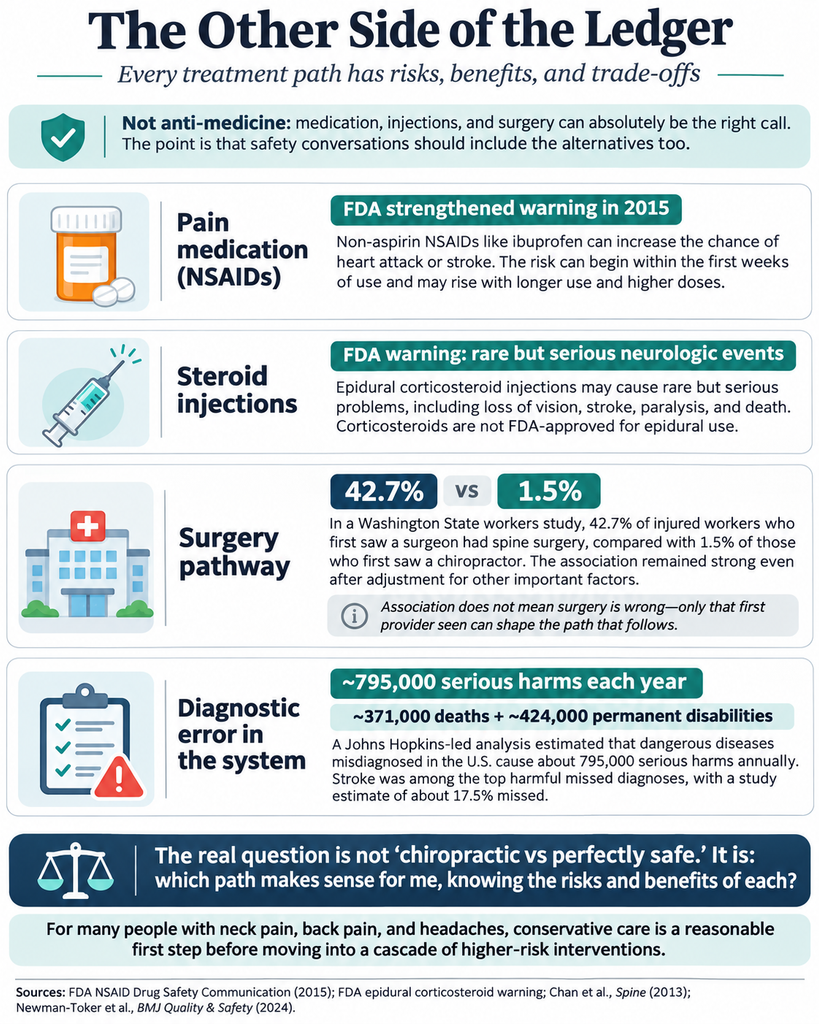
So the real question isn’t “chiropractic vs. perfectly safe.” It’s “which path makes sense for me, knowing the risks and benefits of each?” For many people with neck pain, back pain, and headaches, conservative care that looks for the cause, rather than masking the signal, is a very reasonable first step. It can keep people out of a cascade of interventions that carry much bigger risks.
What This Means for You
If you’re considering chiropractic care, or you have a family member who’s nervous, here’s what I’d recommend:
→ Ask how they evaluate you before adjusting. A thorough history, neurological and orthopedic testing, and imaging when clinically indicated should come first.
→ Tell your chiropractor everything. New or different headaches, recent infections, recent trauma, migraines, connective tissue disorders, osteoporosis, blood thinners, family history of stroke or aneurysm. None of this means you can’t be helped. It means we tailor your care.
→ Speak up if your symptoms are brand new or feel “different.” A new, unusual headache deserves a different thought process than your usual tension.
→ Know you have options. If you’re uncomfortable with a neck adjustment, there are low-force and instrument-based approaches. A good chiropractor will never pressure you.
→ Skip the self-cracking. If your neck constantly feels like it needs to pop, that’s a signal worth getting evaluated, not something to keep forcing.
→ Know the 911 signs listed above, and share them with your family.
Frequently Asked Questions
Can a chiropractic adjustment cause a stroke?
Honestly, no study can prove any treatment has zero risk. But the largest and most carefully designed studies, including a September 2026 study of nearly 863,000 patients, found no increased risk of cervical artery dissection after chiropractic neck adjustments compared with people who got medical care for the same symptoms. Much of the older association appears to come from people seeking care for the early neck pain and headache of a dissection that had already started.
Is it normal to be sore after an adjustment?
It’s not unheard of. Depends on the approach and adjustments made, and mostly the individual themself. Mild soreness or stiffness for a day or two is the most common side effect, similar to the soreness after a new workout. It typically resolves on its own. If you ever feel something that seems unusual or severe, call us, or consult with a physician. Although, quite unlikely.
Can I see a chiropractor if I have arthritis or osteoporosis?
In many cases, yes. Arthritis and disc changes are extremely common, even in people with no pain. These conditions change how we adjust you, which is exactly why we do a full assessment and X-rays first. Certain conditions, like advanced osteoporosis or upper-neck instability, may mean we use gentler techniques, avoid certain areas, or refer you elsewhere.
Do you have to adjust my neck?
No. Your care is built around your assessment, your X-rays, and your comfort level. There are several low-force options, and we’ll always talk through the plan with you before we start.
My doctor told me not to see a chiropractor. Who’s right?
Although I’m sure your doctor is looking out for you… I would challenge them on where they are getting that info. Just like people question and challenge me all the time! It’s good to vouch for your own health. Considering the importance and benefits of chiropractic, avoiding it because of old-wives tales and propoganda from decades ago should not impact your health care choices. I’d encourage you to share this article with them. The newest evidence changes how the question should be framed. The best care usually happens when everyone on your team communicates.
Is it safe to crack my own neck?
I don’t recommend it. Published case reports include serious events after self-manipulation, and repeatedly forcing your own neck isn’t the same as a specific, evaluated adjustment. If your neck constantly feels “stuck,” let’s find out why.
The Bottom Line
No healthcare intervention is perfectly risk-free. Serious events after neck treatments have been reported, and every clinician, chiropractors included, needs to stay alert for vascular warning signs. But the best population-level evidence available keeps pointing the same direction. Chiropractor-delivered neck adjustments do not appear to meaningfully increase the risk of artery dissection compared with getting medical care for the same symptoms. And one big reason this myth has survived for decades is that the earliest symptoms of a dissection are the exact symptoms that bring people to a chiropractor in the first place.
Safety isn’t just about the adjustment. It’s about the right patient, the right assessment, the right technique, and sometimes the wisdom to wait or refer. That’s how we practice. I LOVE being able to give people the full picture on this, because fear shouldn’t keep anyone from care that could genuinely change their life.
If you’ve got questions, or someone in your family is nervous, let’s chat. Book your consultation here, or call my direct line at (612) 470-9210. For scheduling, reach our front desk at (952) 229-8750.
You’re not broken. You’re built to heal.
Dr. Justin Lee, D.C.
Minnetonka Family Chiropractic
11349 Highway 7, Minnetonka, MN 55305
Serving Minnetonka and the west metro Twin Cities

References
- Trager RJ, Baumann AN, Labak CM, et al. Association between spinal manipulative therapy and cervical artery dissection in patients with neck pain or headache: a retrospective cohort study. Chiropr Man Therap. 2026;34:53.
- Trager RJ, Pikus HJ, Perfecto RPT, et al. Association between chiropractic spinal manipulation and adverse vascular events of the head and neck: systematic review and meta-analysis. BMC Neurol. 2026.
- Cassidy JD, Boyle E, Côté P, et al. Risk of vertebrobasilar stroke and chiropractic care: results of a population-based case-control and case-crossover study. Spine. 2008;33(4 Suppl):S176–83.
- Whedon JM, Petersen CL, Li Z, et al. Association between cervical artery dissection and spinal manipulative therapy: a Medicare claims analysis. BMC Geriatr. 2022;22:917.
- Whedon JM, Petersen CL, Schoellkopf WJ, et al. The association between cervical artery dissection and spinal manipulation among US adults. Eur Spine J. 2023;32:3497–504.
- Griffin KJ, Harmsen WS, Mandrekar J, Brown RD, Keser Z. Epidemiology of spontaneous cervical artery dissection: population-based study. Stroke. 2024;55:670–7.
- Yaghi S, Engelter S, Del Brutto VJ, et al. Treatment and outcomes of cervical artery dissection in adults: a scientific statement from the American Heart Association. Stroke. 2024;55:e91–e106.
- Fagundes C, Duarte FCK, Herzog W. Strain in vertebral artery during passive cervical range of motion and spinal manipulation therapy: a systematic review and meta-analysis. Clin Biomech. 2025;130:106685 (corrigendum 2026;132:106721).
- Gorrell LM, Sawatsky A, Edwards WB, Herzog W. Vertebral arteries do not experience tensile force during manual cervical spine manipulation applied to human cadavers. J Man Manip Ther. 2023;31:261–9.
- Chu EC, Trager RJ, Lee LYK, Niazi IK. A retrospective analysis of the incidence of severe adverse events among recipients of chiropractic spinal manipulative therapy. Sci Rep. 2023;13:1254.
- Gorrell LM, Brown BT, Engel R, Lystad RP. Reporting of adverse events associated with spinal manipulation in randomised clinical trials: an updated systematic review. BMJ Open. 2023;13:e067526.
- Leung B, Treleaven J, Marsh L, Thomas L. Serious adverse events associated with conservative physical procedures directed towards the cervical spine: a systematic review. J Bodyw Mov Ther. 2025;41:56–77.
- Leung B, Treleaven J, Marsh L, Thomas L. Are serious adverse events associated with conservative physical procedures of the neck potentially preventable? A sub-analysis of a systematic review. J Bodyw Mov Ther. 2025;44:691–707.
- Brinjikji W, Luetmer PH, Comstock B, et al. Systematic literature review of imaging features of spinal degeneration in asymptomatic populations. AJNR Am J Neuroradiol. 2015;36:811–6.
- Swait G, Finch R. What are the risks of manual treatment of the spine? A scoping review for clinicians. Chiropr Man Therap. 2017;25:37.
- Keeney BJ, Fulton-Kehoe D, Turner JA, et al. Early predictors of lumbar spine surgery after occupational back injury. Spine. 2013;38(11):953–64.
- Newman-Toker DE, et al. Burden of serious harms from diagnostic error in the USA. BMJ Qual Saf. 2023 (published online July 17, 2023).
- U.S. Food and Drug Administration. Drug Safety Communication: Risk of rare but serious neurologic problems after epidural corticosteroid injection. April 23, 2014.
- U.S. Food and Drug Administration. Drug Safety Communication: FDA strengthens warning that non-aspirin NSAIDs can cause heart attacks or strokes. July 9, 2015.
- Adverse events following cervical spine self-manipulation: a systematic review. 2026. [Add authors and journal before publishing]
Dr. Justin Lee, D.C.
Doctor of Chiropractic & Holistic Health
Dr. Justin Lee is a passionate chiropractor who believes in the innate healing potential within you. This passion stems from a personal experience in collegiate hockey, competitive CrossFit, and a relentless pursuit to holistically optimize performance and recovery. His professional mission is to help as many individuals and families as possible uncover the path to true health. He is dedicated to guiding them on how to integrate lifestyle changes for a sustainable and healthier future. All of which shapes his unique approach to personalized chiropractic care.
You are one ‘aJUSTINment’ away from a healthier life.

get to know me

