Dr.'s Blog
Stress Fracture? Yep, SUCKS. But, Here’s What You CAN Do to Help it Heal Faster.
October 14, 2026
What’s Actually Happening Inside a Stress Fracture — And What Can be Done About It
Every runner, CrossFitter, or weekend warrior who’s been handed a stress fracture diagnosis has heard some version of the same advice: stop running, wear a boot, come back in six to eight weeks, and hope for the best. Nobody explains what’s actually happening in the bone, and almost nobody addresses why it happened in the first place. You just wait.
I don’t think “wait and hope” is good enough, and — this is going to matter later in this article — the research doesn’t think so either. A stress fracture isn’t a mystery injury. It’s a specific, understandable breakdown in bone biology, and there’s a growing body of legitimate research on how a mechanical acoustic signal like SoftWave can support the actual repair process, not just the pain.
Let’s dive in.
THE SHORT VERSION
→ A stress fracture happens when repetitive loading creates microscopic bone damage faster than your body can repair it. It’s biology losing a race against mechanical stress, not a random injury (ok, some cases maybe more ‘random’ than others).
→ Bone is mechanosensitive — shockwave research shows it can activate vascular signaling (VEGF, eNOS) and osteoblast activity that bone repair actually depends on.
→ The direct clinical evidence in runners and athletes with stress fractures is genuinely encouraging — still more research to do, and doesn’t give a definitive healing timeline. But, that’s life.
→ The evidence gets considerably stronger for bone that’s stalled — delayed unions and nonunions — where shockwave has real, well-documented human data behind it.
→ SoftWave can support bone biology. It can’t fix why the bone broke down in the first place. That part is on training load, recovery, and nutrition — and it’s usually the part that actually prevents this from happening again.
TABLE OF CONTENTS
- What a Stress Fracture Actually Is
- Why Would a Mechanical Pulse Help Broken Bone?
- The Direct Evidence in Runners and Athletes
- Where the Evidence Gets Even Stronger: Stalled Bone
- Being Honest About What We Don’t Know Yet
- SoftWave Can’t Fix Why the Bone Broke Down
- What This Looks Like as an Action Plan
- A Note on Rest, Medication, and What to Avoid
- The Bottom Line
- FAQ
- What To Do Next
1. What a Stress Fracture Actually Is
A stress fracture develops on a continuum, not as a single event: early bone stress reaction → marrow and periosteal edema → cortical injury → a visible fracture line → and, if it’s not managed well, a delayed union or nonunion. It happens when repetitive loading outpaces your bone’s ability to remodel and rebuild — training volume, surface, footwear, biomechanics, and how well-fed and well-rested your skeleton actually is all factor into which side of that race your bone ends up on.
That framing matters, because it sets up the whole rest of this article: if a stress fracture is a biological process losing a race, the question isn’t just “how do we make it stop hurting.” It’s “how do we help the biology win.”
2. Why Would a Mechanical Pulse Help Broken Bone?
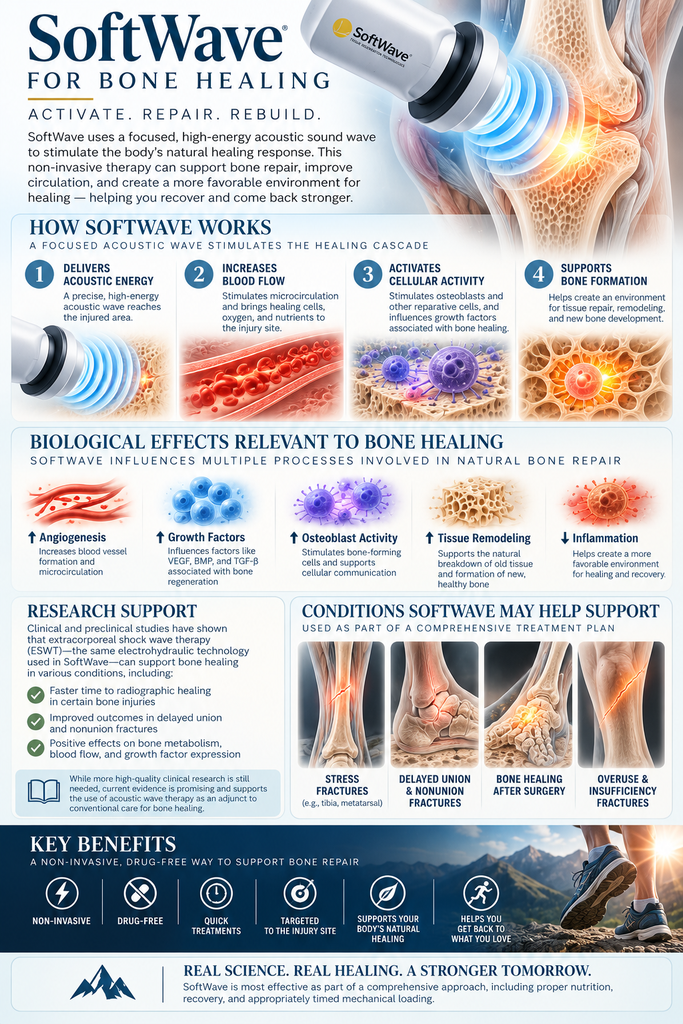
This is where it gets genuinely interesting, because the mechanism is more sophisticated than the old idea that shockwave just creates microscopic disruption. Modern research describes it through mechanotransduction — cells detecting a mechanical stimulus and converting it into regenerative signaling involving osteoblasts, vascular cells, and growth factors.
Vascular signaling comes first, and it may be the whole ballgame. Healing bone needs blood supply before it needs anything else. Shockwave research shows increased VEGF and eNOS signaling and new blood vessel formation in experimental fracture models — and in one of the more telling experimental findings, when researchers blocked VEGF directly, much of shockwave’s bone-healing effect disappeared. That suggests the vascular signaling isn’t incidental to the effect. It may be central to it.
Osteoblast activity — the actual bone-building cells. Human osteoblast and fibroblast research has shown increased FGF-2 (a key regulator of bone formation) after shockwave exposure, along with other osteogenic signaling.
Bone morphogenetic proteins. Preclinical research has shown increased expression of BMP-2, BMP-3, BMP-4, and BMP-7 after shockwave exposure — proteins directly involved in osteogenic differentiation and fracture repair.
And this is where it stops being theoretical. In 42 people with established femoral or tibial nonunions treated with shockwave, 78.6% achieved radiographic union by six months — and the people who healed showed significantly greater increases in nitric oxide, TGF-β1, VEGF, and BMP-2 after treatment than those whose fractures stayed ununited (Nitric Oxide, Wang et al., 2009). That’s not just a mechanism in a dish. That’s the mechanism tracking with who actually healed and who didn’t, in real patients.
Put together, the sequence looks like this: mechanical signal → cellular mechanotransduction → vascular and growth-factor response → osteoblast activation → new bone formation and remodeling. That’s a considerably more interesting story than “shockwave reduces the pain of a stress fracture” — and it’s also a more accurate one.
3. The Direct Evidence in Runners and Athletes
Mechanism is one thing. What happens in actual injured athletes is another, and this is where the research gets specific.
Runners with bone stress injuries. A 2023 retrospective study followed 40 runners with 41 bone stress injuries treated with focused shockwave therapy, averaging 5 ± 2 treatments. All but one runner returned to pain-free running — the single exception had a grade 4 navicular nonunion and chose surgery instead. Runners who started treatment within 3 months of diagnosis returned to running in an average of 12.0 ± 7.5 weeks; those with delayed union or nonunion took meaningfully longer, 19.8 ± 14.8 weeks (Bioengineering, Beling et al., 2023). No treatment-related complications were reported.
Soccer players, head-to-head against surgery. This next one is worth sitting with. Eighteen soccer players with proximal fifth-metatarsal stress fractures — a notoriously stubborn injury that often gets fast-tracked to surgery — were randomized to either intramedullary screw fixation or high-energy focused shockwave therapy, once weekly for three weeks (using an electrohydraulic device, the same underlying technology category as SoftWave). At final follow-up, there was no statistically significant difference between the surgery group and the shockwave group in bone healing, pain relief, function, or time to return to play. No complications occurred in either group (Foot Ankle Int., Ramon et al., 2023).
I want to be direct about the limits of that finding, because that’s exactly the kind of honesty that makes the rest of this article trustworthy: it’s a pilot study with only 18 athletes. It would be irresponsible to conclude from 18 people that shockwave is equivalent to surgery for every fifth-metatarsal fracture. But a fracture location where surgery is often the reflexive recommendation, showing statistically equivalent outcomes to a noninvasive option with zero complications in either arm, is a genuinely meaningful signal — not a marginal one — and it’s exactly why the authors themselves called for larger trials rather than declaring victory.
An earlier, smaller case series (Moretti et al., 2009) reported similarly encouraging outcomes in athletes with chronic tibial and fifth-metatarsal stress fractures using several sessions of shockwave, with radiographic healing and eventual return to sport. It’s a small retrospective series — promising, not definitive, and I’m labeling it that way on purpose.
4. Where the Evidence Gets Even Stronger: Stalled Bone
If there’s one place the shockwave-and-bone story moves from “encouraging” to “genuinely strong,” it’s delayed unions and nonunions — bone that has flat-out stopped healing on its own.
A meta-analysis of 1,200 long-bone nonunions found 876 healed — 73% overall — after shockwave therapy, with healing rates reaching roughly 90% for metatarsals and 75.5% for tibias, and union rates continuing to climb even beyond six months after treatment. That last detail connects directly to something worth remembering from everything else we’ve discussed about SoftWave: the biological response doesn’t stop when the treatment session ends.
And that’s on top of the Wang et al. finding from the previous section — 78.6% union in established nonunions, tracking with measurable increases in the exact growth factors this mechanism is supposed to activate.
5. What We Don’t Know Yet
Here’s the important limitation in the runner data specifically: there was no untreated control group in that study. A separate study of collegiate athletes — without shockwave therapy — found typical stress-fracture return-to-sport times already averaging roughly 12 to 13 weeks, depending on location and severity. That number is strikingly close to the 12-week average return time in the shockwave study.
So here’s the honest conclusion, not the exciting one: the current evidence supports “shockwave therapy appears capable of supporting bone-stress-injury healing and safe return to sport, especially once healing has stalled.” It does not yet establish “shockwave makes every acute stress fracture heal in half the time.” Those are different claims, and only the first one is something I can stand behind.
I’d also add one more important distinction: most of this research is on shockwave therapy as a broad category, using a range of devices and energy settings — some considerably higher-energy than routine musculoskeletal treatment, and some historical fracture protocols even required sedation. SoftWave is electrohydraulic technology, which places it biologically within this research category, and the company’s own clinical protocols include a specific bone/stress-fracture application. Our SoftWave unit is also the only FDA cleared device as well. But I’m not going to tell you the exact dose we use for a tennis elbow has been independently proven to heal a tibial stress fracture — that’s a different statement than “this technology has real bone-healing research behind it,” and conflating the two is exactly the kind of overreach this article is trying to avoid.
6. SoftWave Can’t Fix Why the Bone Broke Down
This might be the most important section for actually preventing this from happening again — and it’s also exactly where our whole approach to care comes in.
A stress fracture doesn’t happen in a vacuum. In the runner study referenced above, 63% of the athletes already met criteria for moderate- or high-risk Female or Male Athlete Triad categories — meaning low energy availability, in plain terms, chronic under-fueling relative to training demand, was already present in the majority of these cases before the fracture ever showed up. SoftWave can help stimulate local bone repair. It cannot fix an athlete who’s chronically under-fueled and running 50 miles a week on a bone that never had the resources to keep up.
The honest, full list of what actually needs attention alongside treatment:
→ Training-load spikes and repetitive impact — did volume or intensity ramp up faster than the bone could adapt → Recovery between sessions — is there enough of it, or is fatigue accumulating unchecked → Energy availability — enough total calories relative to training demand, not just “eating healthy” → Protein and calcium intake specifically → Vitamin D status → Menstrual and hormonal health, when relevant → Sleep — bone remodeling, like soft tissue remodeling, happens disproportionately during real sleep → Bone density history and previous stress fracture history → Biomechanics, footwear, and recent surface changes
SoftWave can provide the signal. You still have to supply the building materials and remove the reason the bone broke down faster than it could rebuild in the first place. That’s not a disclaimer tacked onto the end of a sales pitch — it’s the actual philosophy behind how we treat this, and it’s why we look at the whole picture instead of just the fracture line on the X-ray.
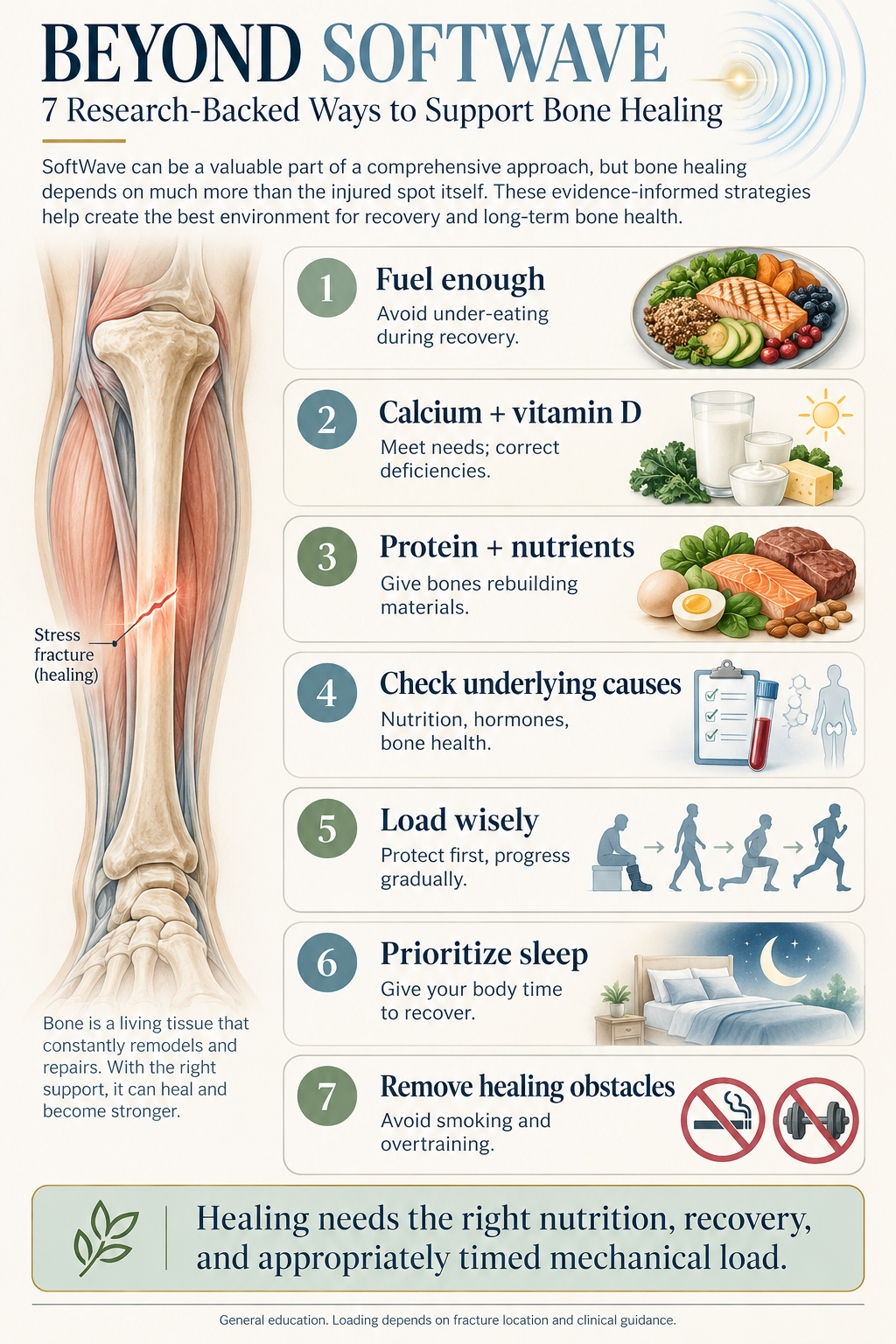
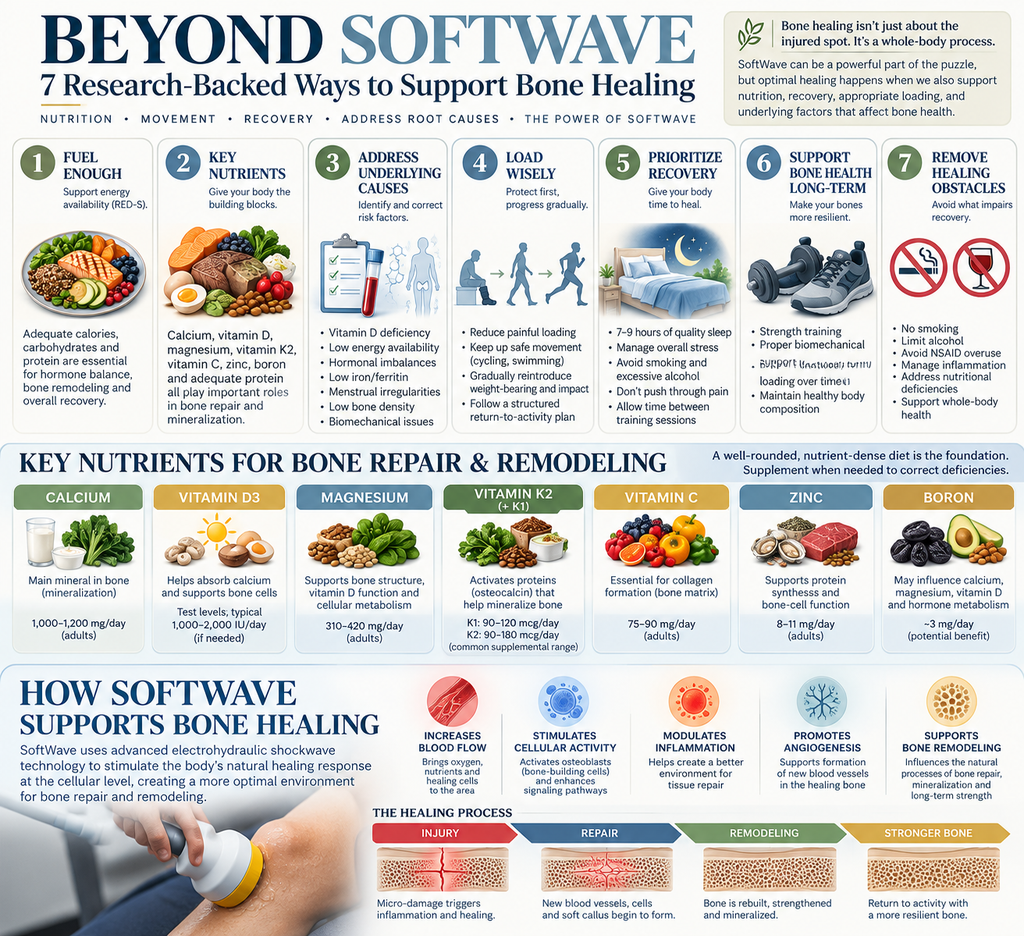
Beyond SoftWave: 7 Ways to Support Bone Healing From the Inside Out
When someone develops a stress fracture, it’s tempting to focus entirely on the injured bone. But bone healing doesn’t happen in isolation. It depends on adequate nutrition, hormonal health, appropriate mechanical loading, circulation, and the body’s ability to rebuild damaged tissue.
And while there’s no nutritional shortcut that guarantees a faster recovery, there are several research-supported strategies that can help create a better environment for healing.
1. Make sure you’re actually eating enough
This is one of the most overlooked factors, especially in runners, CrossFit athletes, and people who regularly exercise at high intensity.
Your body requires energy not only to fuel workouts, but also to maintain healthy hormone production, remodel bone, and repair damaged tissue.
When someone consistently burns more energy than they replace, they can develop what’s known as Relative Energy Deficiency in Sport (RED-S). This can interfere with bone health and increase the likelihood of stress fractures—even in someone who otherwise looks extremely healthy.
During recovery, adequate overall calories, carbohydrates, and protein should be priorities. A stress-fracture recovery period is generally not the ideal time for aggressive dieting or intentional weight loss.
2. Pay attention to calcium and vitamin D
Calcium provides essential mineral content for bone, while vitamin D helps regulate calcium absorption and bone metabolism.
One randomized trial involving more than 5,000 female Navy recruits found that calcium and vitamin D supplementation reduced the incidence of stress fractures by approximately 20% during training.
That’s an important finding, although the study examined preventing new stress fractures, not how quickly existing fractures healed.
For most adults, aiming for approximately 1,000–1,200 mg of calcium daily from food and, when necessary, supplements is a reasonable starting point, depending on age and sex. Vitamin D needs vary, and checking levels can be particularly useful in someone with repeated stress fractures or other risk factors for deficiency.
More isn’t necessarily better. The goal is to correct inadequate intake or deficiency—not assume that megadoses make bones heal faster.
3. Give your body enough protein and other essential nutrients
Bone is more than calcium. It’s a living tissue containing a collagen-rich protein matrix that provides the structural framework for mineral deposition.
Protein supplies amino acids used to build and maintain that matrix. For physically active adults, approximately 1.4–2.0 grams of protein per kilogram of body weight daily is a commonly supported sports-nutrition range, though it hasn’t been proven to specifically accelerate stress-fracture healing.
It’s also worth including foods rich in vitamin C, magnesium, vitamin K, zinc, and other nutrients involved in normal bone metabolism.
Think quality protein, eggs, dairy or fortified alternatives, fish, meat, legumes, leafy greens, fruits, vegetables, nuts, and seeds.
The goal isn’t to take a dozen supplements. It’s to make sure your body has the raw materials necessary to do the rebuilding.
4. Consider why your bone may have become vulnerable
Sometimes the fracture itself is only part of the problem.
Low vitamin D, inadequate energy intake, iron deficiency, hormonal abnormalities, and compromised bone density can all be relevant, especially when stress fractures happen repeatedly.
A recent sports-medicine review recommends considering vitamin D testing, a complete blood count, and iron studies for athletes with bone stress injuries. Additional testing may be appropriate depending on the patient’s history.
For women, menstrual irregularities can be an important clue to low energy availability and hormonal disruption. Men can experience similar problems involving reduced testosterone and other hormonal changes.
Identifying an underlying problem may be just as important as treating the injured area.
5. Understand that appropriate rest is part of active healing
Bone responds to mechanical loading. That’s part of what makes it such a remarkable tissue.
But when repetitive loading has already exceeded the bone’s capacity to recover, continuing to run, jump, or train through significant pain can make the injury worse.
Depending on the injury’s location and severity, temporary unloading, activity modification, or even immobilization may be necessary.
As healing progresses, carefully controlled loading helps the bone and surrounding tissues adapt again. This might involve rehabilitation exercises, gradual strengthening, and eventually a structured return to running or impact activity.
The key is choosing the right amount of stress at the right stage of recovery—not simply pushing through pain or assuming that complete inactivity is always best.
6. Take sleep and recovery seriously
Sleep plays an important role in normal metabolic, endocrine, and tissue-repair processes.
Although research hasn’t established that sleeping a specific number of extra hours will shorten stress-fracture healing time, consistently inadequate sleep can compromise overall recovery and training readiness.
For most adults, aiming for 7–9 hours of quality sleep is a reasonable goal, with individual needs varying.
And remember that recovery isn’t only about sleep. It also means allowing enough time between demanding training sessions for tissues to adapt.
7. Remove the obstacles that may be working against healing
Sometimes supporting recovery is less about adding another treatment and more about removing factors that interfere with normal repair.
Smoking is a particularly important example. Research across orthopedic fracture populations has consistently linked smoking with an increased risk of delayed healing and nonunion.
Avoiding smoking, limiting heavy alcohol consumption, correcting nutritional deficiencies, and not repeatedly using pain medication to push through an active bone injury are all sensible considerations. And then there are more subtle things that I’ve talked about nonstop for years that interfere with your body’s innate ability to heal; toxins in our environment, stress, poor quality sleep, etc. So just take inventory about the things that might be getting in your way of healing optimally.
Ultimately, the goal isn’t simply to make the pain disappear. It’s to help the bone heal, restore its capacity to handle normal loads, and reduce the chance of another injury.

7. What This Looks Like as an Action Plan
If you’re dealing with a suspected or confirmed stress fracture, here’s the sequence that reflects what the evidence above actually supports:
Get real imaging and a real diagnosis first. Location and grade matter enormously for how this gets handled — a grade 1 tibial stress reaction and a proximal fifth-metatarsal stress fracture are not the same conversation.
Start treatment earlier rather than later, if shockwave is appropriate for your case. The data above is fairly consistent on this point: athletes treated within three months of diagnosis returned to activity meaningfully faster than those whose cases became delayed unions or nonunions before treatment started. Waiting to “see if it heals on its own” isn’t automatically the cautious choice — sometimes it’s the choice that turns a straightforward injury into a stalled one.
Expect a course, not a single session. The research above generally used somewhere in the range of 3 to 5 treatments, sometimes with additional sessions during the return-to-activity progression — not one visit and done.
Respect an appropriate period of relative unloading — not necessarily complete immobility. What “appropriate” means depends entirely on the location and grade of your specific injury, which is exactly why this needs individualized guidance rather than a generic internet protocol.
Address the reason it happened, in parallel — not after the fact. Training load, energy availability, calcium and vitamin D status, sleep, and biomechanics all get evaluated alongside treatment, not as an afterthought once the bone is healed. Fixing the bone and ignoring why it broke down is how people end up back in this exact conversation a year later.
Follow a structured return-to-activity progression, not a light switch. Every study referenced above that showed strong outcomes paired treatment with a graded return — walk-run progressions, gradual reintroduction of load — rather than clearing someone to immediately resume full training the moment imaging looked better.
8. A Note on Rest, Medication, and What to Avoid
On NSAIDs: the instinct to reach for ibuprofen when something hurts is about as common as advice gets, so let’s go past the obvious and into what actually matters for bone specifically. I’m not going to tell you that a dose here or there is destroying your healing capacity — that’s not what the broader evidence on NSAIDs and bone healing shows. What I will say plainly: if you’re leaning on them reflexively, week after week, as a way to keep training through a bone that’s already struggling, that pattern is working directly against the biology this entire article has been describing. The concern was never a single pill. It’s the habit of using medication to override a signal your body is actively trying to send you.
On complete rest as the default plan: “just stop and wait” sounds like the safe, conservative choice, and sometimes appropriate unloading absolutely is the right call. But rest without addressing training load, energy availability, and bone health doesn’t fix the underlying problem — it just pauses the clock until you go back to doing the exact same thing that caused it. Passive waiting isn’t the same as active healing, and the evidence throughout this article backs that distinction up.
On calcium and vitamin D: these deserve real attention rather than a vague “eat healthy” suggestion, especially if energy availability or hormonal health is already a concern. This is exactly the kind of thing worth discussing specifically at your visit rather than guessing at a dose on your own.
9. The Bottom Line
→ A stress fracture is bone losing a race between damage and repair — not a random unlucky injury. → Bone is genuinely mechanosensitive, and shockwave research shows real, plausible biology behind using it to support that repair — vascular signaling, osteoblast activity, and specific growth factors that track with who actually heals. → The direct evidence in runners and athletes is genuinely encouraging, especially once bone has stalled into a delayed union or nonunion — and I’d rather tell you exactly where that evidence is strong and where it’s still limited than oversell either direction. → SoftWave can support the biological signal. It can’t replace addressing training load, energy availability, and bone health — and skipping that part is how this happens again. → This works best as an active, multi-part plan — not a single treatment and not just waiting it out.
FAQ
Can SoftWave actually heal a stress fracture, or just manage the pain? The research suggests it does more than manage pain — it appears to activate vascular and bone-building signaling (VEGF, osteoblast activity, specific growth factors) that real bone repair depends on. That said, the strongest direct evidence is in bone that’s stalled (delayed union or nonunion) and in athlete case series, not in large controlled trials of acute stress fractures yet. I’d rather give you that honest picture than an inflated one.
Is this the same as what SoftWave does for a tendon or muscle strain? The underlying mechanism (mechanotransduction) is related, but bone-specific protocols and research often use different treatment parameters than routine soft-tissue tendinopathy treatment. We’ll talk through what’s appropriate for your specific injury rather than applying a one-size-fits-all approach.
Do I still need to stay off it? Almost always, some degree of relative unloading is appropriate — the question is how much and for how long, which depends on your specific fracture location and grade. Complete inactivity for months isn’t automatically the right answer either.
Why did my stress fracture happen if I wasn’t training that hard? Often it’s not just training volume — energy availability (are you eating enough for what you’re asking your body to do), sleep, hormonal health, calcium and vitamin D status, and biomechanics all factor in. In one study of runners with bone stress injuries, nearly two-thirds already showed signs of chronic under-fueling before the fracture appeared.
How many SoftWave sessions will I need? Based on the research above, most protocols for bone applications run somewhere around 5 sessions, sometimes with additional sessions during the return-to-activity phase — but this depends heavily on your specific injury and how it responds.
Can this replace surgery for something like a fifth-metatarsal stress fracture? There’s genuinely interesting pilot data showing comparable outcomes to surgery in a small trial — but it was only 18 athletes, and the researchers themselves called for larger studies before treating that as settled. This is absolutely a conversation to have directly, not a decision to make from an article.
What To Do Next
If you’re dealing with a suspected or diagnosed stress fracture — or you’ve been told to “just rest it” and you want a more complete plan than that — the right next step is getting an actual assessment so we know exactly what we’re dealing with and why it happened.
If you’re local to the west metro Twin Cities, go ahead and grab a time on the calendar and we’ll walk through your specific situation before talking about any treatment plan.
If you’re already a patient working through this, bring your training history and any imaging you have to your next visit — the more complete picture we have, the better this plan works.
Ready to get started? Here’s the link to get on the schedule — or call the office direct at 952-229-8750.
Minnetonka Family Chiropractic | 11349 Highway 7, Minnetonka, MN 55305 | 952-229-8750
— Dr. Justin Lee, D.C.
REFERENCES
- Beling A, Saxena A, Hollander K, Tenforde AS. Outcomes Using Focused Shockwave for Treatment of Bone Stress Injury in Runners. Bioengineering (Basel). 2023;10(8):885.
- Ramon S, Lucenteforte G, Alentorn-Geli E, et al. Shockwave Treatment vs Surgery for Proximal Fifth Metatarsal Stress Fractures in Soccer Players: A Pilot Study. Foot Ankle Int. 2023;44(12):1256-1265.
- Wang CJ, Yang KD, Ko JY, Huang CC, Huang HY, Wang FS. The effects of shockwave on bone healing and systemic concentrations of nitric oxide (NO), TGF-beta1, VEGF and BMP-2 in long bone non-unions. Nitric Oxide. 2009;20(4):298-303.
- Extracorporeal Shockwave Therapy in the Treatment of Nonunion in Long Bones: A Systematic Review and Meta-Analysis. 2022.
- Moretti B, Notarnicola A, Moretti L, et al. Shock waves in the treatment of stress fractures. (Case series, 2009.)
Editor’s note for Dr. Lee: independently re-verified this pass, matching exactly — Beling et al. 2023 (runners), Ramon et al. 2023 (soccer players vs. surgery, including the detail that the shockwave arm used an electrohydraulic device), and Wang et al. 2009 (NO/TGF-β1/VEGF/BMP-2, 78.6% union). The 1,200-nonunion meta-analysis (73% overall, site-specific rates) was verified in an earlier session. Not independently re-verified this pass: the VEGF-blocking rabbit fracture-model study, the FGF-2 human osteoblast/fibroblast study, the BMP-2/3/4/7 preclinical expression study, the Moretti et al. 2009 case series specifics, the exact 86%/73%/81% delayed-union/nonunion/nonunion-after-surgery breakdown attributed to a 2019 systematic review, the Prisco et al. 2026 systematic review, and the collegiate-athlete 12–13-week baseline return-to-sport figure used as an informal comparison. These are presented with appropriately hedged language, but given how much weight Sections 2 and 5 place on a few of them, I’d verify before publishing — particularly the collegiate-athlete baseline, since that’s the number doing the most work in the “being honest about what we don’t know” section.
Dr. Justin Lee, D.C.
Doctor of Chiropractic & Holistic Health
Dr. Justin Lee is a passionate chiropractor who believes in the innate healing potential within you. This passion stems from a personal experience in collegiate hockey, competitive CrossFit, and a relentless pursuit to holistically optimize performance and recovery. His professional mission is to help as many individuals and families as possible uncover the path to true health. He is dedicated to guiding them on how to integrate lifestyle changes for a sustainable and healthier future. All of which shapes his unique approach to personalized chiropractic care.
You are one ‘aJUSTINment’ away from a healthier life.

get to know me

