Dr.'s Blog
The Top 10 Conditions SoftWave Therapy Can Transform – And Why Your Body Actually Responds
January 28, 2026
Here’s something that’s been absolutely GAME-CHANGING in our practice…
After 7+ years of helping patients through specific chiropractic adjustments, targeted nutrition, and lifestyle changes, I added a technology to our clinic that’s taking results to a whole new level:
SoftWave Therapy.
And I’m not going to sugarcoat it – I’m genuinely blown away by what we’re seeing.
But before you think this is just another “magic treatment” promising overnight miracles, let me be clear: this isn’t about chasing symptoms. This is about activating your body’s own healing mechanisms at a cellular level.
Think about this for a second: Your body built itself from 2 cells into over 70 trillion cells working in perfect harmony. That same biological intelligence is STILL there – it just sometimes needs the right signal to bypass whatever’s been blocking it.
That’s exactly what SoftWave does. It doesn’t “fix” you. It removes the interference so your body can finally do what it was designed to do: heal.
What Makes SoftWave Different From Everything Else You’ve Tried
SoftWave (electrohydraulic unfocused shockwave therapy) isn’t a pain treatment. It’s a biological switch.
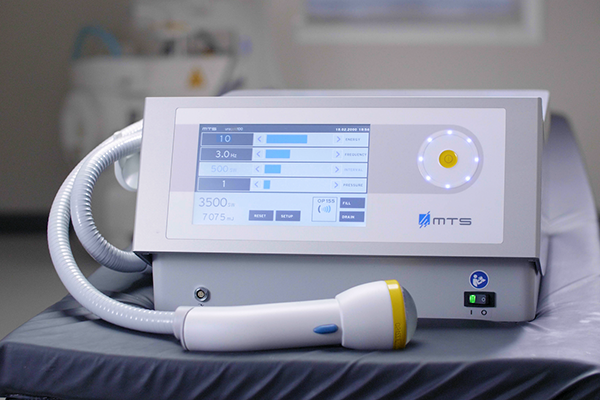
Here’s what happens at the cellular level when we deliver these acoustic pressure waves to injured or degenerative tissue:
Angiogenesis → Your body creates NEW blood vessels, bringing oxygen and nutrients to tissue that’s been starving for circulation. Studies show increases in VEGF (vascular endothelial growth factor) by 200-300% within days. (Wang et al., 2003; Mariotto et al., 2009)
Stem Cell Recruitment → SoftWave creates a “homing signal” that attracts mesenchymal stem cells to the treatment area. These are your body’s repair cells – and they can differentiate into whatever tissue type you need (muscle, tendon, cartilage, bone, etc.). (Notarnicola et al., 2012)
Nerve Modulation → Hypersensitive pain nerves get “turned down.” SoftWave reduces substance P and CGRP (the neurotransmitters driving chronic pain) by up to 50-70% in treated tissues. (Hausdorf et al., 2008)
Reduced Neurogenic Inflammation → The inflammatory chemicals that keep pain cycles going? They get cleared. C-fiber nerve activity normalizes. The “pain loop” gets broken. (Takahashi et al., 2007)
Improved Tissue Metabolism → Mitochondria (your cells’ energy factories) ramp up ATP production. Cells that were barely surviving suddenly have the fuel to HEAL. (d’Agostino et al., 2015)
Collagen Remodeling → Instead of leaving behind weak, disorganized scar tissue, SoftWave stimulates fibroblasts to produce properly aligned, functional collagen. This is the difference between tissue that’s “healed” versus tissue that’s actually STRONG. (Notarnicola & Moretti, 2012)
Accelerated Regeneration → Growth factors, TLR3 signaling, eNOS activation – these are the molecular pathways that may have been dormant for MONTHS or YEARS. SoftWave flips them back on. (Császár et al., 2015)
When you understand these mechanisms, you start to see why SoftWave helps conditions that have been “stuck” for months or even years.
It’s not masking symptoms. It’s changing the biological environment that was preventing healing in the first place.
The Top 10 Areas Where We’re Seeing Incredible Results
Based on the research and what we’re witnessing firsthand in practice, here are the body regions and conditions where SoftWave is making the biggest impact:
1. Low Back & Hip Pain (Disc Issues, Sciatica, SI Joint Dysfunction, Hip Impingement)
Low back pain is the #1 reason people miss work and one of the most common reasons people come to our office.
But here’s what most people don’t realize: chronic low back pain is rarely just a “muscle issue.”
It usually involves:
- Degenerative disc changes (loss of disc height, desiccation, bulging)
- Facet joint inflammation (the small joints in your spine)
- Nerve irritation (compressed or hypersensitized nerve roots)
- SI joint dysfunction (the connection between your spine and pelvis)
- Hip pathology referring pain to the low back
- Muscle guarding and trigger points that won’t release
- Poor circulation to deep spinal structures
- Chronic inflammation in ligaments and soft tissue
Traditional treatment usually focuses on ONE piece: muscle relaxers, steroid injections, pain meds, or generic stretching. But that doesn’t address the whole picture.
How SoftWave Addresses Low Back & Hip Pain:
✅ Reduces disc-related inflammation – Studies show shockwave can decrease inflammatory markers around degenerated discs, reducing nerve root irritation. (Ohtori et al., 2011)
✅ Improves facet joint circulation – bringing nutrients to degenerative joint surfaces
✅ Calms hypersensitized nerve roots – reducing substance P and CGRP that drive sciatica pain
✅ Releases deep muscle trigger points that manual therapy can’t reach
✅ Stimulates healing in SI joint ligaments and surrounding connective tissue
✅ Addresses hip labral pathology and impingement – studies show shockwave improves hip joint function and reduces pain in FAI (femoroacetabular impingement) patients (Farr et al., 2014)
✅ Improves microcirculation to chronically tight muscles (piriformis, psoas, glute medius)
We’re seeing patients who’ve been stuck in chronic low back and hip pain cycles for YEARS finally getting relief – not just temporary symptom suppression, but actual tissue-level changes that allow them to move, function, and live without constant pain.
2. Neck, Traps & Upper Back Pain (Cervical Disc Issues, Chronic Tension, Postural Strain)
If you spend any time at a desk, driving, or looking at screens, you know this pain: chronic neck tension, trap tightness, upper back “knots” that never fully release.
Most people think it’s just “stress” or “posture.” And while those contribute, the real issue is usually:
- Cervical disc degeneration (loss of disc height putting pressure on nerves)
- Facet joint arthritis in the neck
- Nerve root irritation (causing referral pain into shoulders, arms, and even headaches)
- Chronic muscle hypertonicity – muscles stuck in a contracted state
- Trigger points in upper traps, levator scapulae, rhomboids
- Poor blood flow to chronically tense muscles
- Forward head posture creating mechanical overload
- Myofascial restrictions limiting movement
Anti-inflammatories and muscle relaxers provide temporary relief. Massage feels good but doesn’t last. Even adjustments help, but if the tissue itself is degenerative or hypoxic, the problem keeps coming back.
How SoftWave Transforms Neck & Upper Back Issues:
- Reduces cervical disc inflammation – decreasing nerve root compression and referral pain
- Improves circulation to chronically tight muscles – finally getting oxygen and nutrients to tissue that’s been hypoxic
- Releases deep trigger points in traps, levator, scalenes, suboccipitals
- Modulates hypersensitive nerve fibers in the cervical spine – reducing headache and arm pain
- Breaks up fascial adhesions between muscle layers that restrict movement
- Stimulates collagen remodeling in overstretched or damaged ligaments
Studies show shockwave therapy significantly reduces chronic neck pain and improves cervical range of motion – with effects lasting months after treatment. (Kim et al., 2015)
Patients report:
- Less morning stiffness
- Reduced headache frequency
- Better sleep (not waking up from neck pain)
- Ability to work at computers without constant discomfort
- Improved posture without having to “force it”
3. TMJ Pain & Jaw Dysfunction (TMD, Bruxism, Clicking, Limited Opening)
TMJ (temporomandibular joint) dysfunction is incredibly frustrating – and incredibly common.
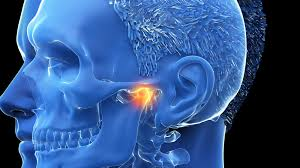
It causes:
- Jaw pain and clicking
- Headaches and migraines
- Ear pain and fullness
- Difficulty chewing
- Limited mouth opening
- Neck and shoulder tension
Most treatments focus on bite guards, muscle relaxers, or telling people to “stop clenching” (as if that’s helpful). But the real issue is usually:
- Chronic inflammation in the TMJ capsule
- Disc displacement within the joint
- Muscle hypertonicity (masseter, temporalis, pterygoids)
- Trigger points in jaw muscles
- Poor joint lubrication (loss of synovial fluid)
- Nerve sensitization around the joint
- Fascial restrictions limiting movement
How SoftWave Addresses TMJ Dysfunction:
- Reduces inflammation in the TMJ capsule – calming the joint environment
- Improves synovial fluid production – better joint lubrication
- Releases masseter and temporalis trigger points – reducing clenching force
- Modulates hypersensitive nerve fibers around the joint – reducing pain
- Increases blood flow to the joint – supporting healing
- Breaks up fascial adhesions that limit jaw opening
Research shows shockwave therapy significantly reduces TMJ pain and improves maximum mouth opening in chronic TMD patients. (Al-Moraissi et al., 2020)
We’re seeing patients:
- Reduce or eliminate headaches tied to jaw tension
- Open their mouths wider without pain or clicking
- Sleep better (less nighttime clenching)
- Chew food normally again
- Reduce reliance on bite guards
4. Golfer’s Elbow & Tennis Elbow (Medial & Lateral Epicondylitis)
Tennis elbow (lateral epicondylitis) and golfer’s elbow (medial epicondylitis) are two of the MOST researched conditions for shockwave therapy.
And for good reason – they’re incredibly common and notoriously stubborn.
Here’s what’s really happening in chronic elbow tendinopathy:
- Degenerative collagen changes in the tendon (not inflammation)
- Pathological nerve ingrowth into the tendon attachment
- Neovascularization (abnormal blood vessel + nerve growth)
- Hypoxia (poor oxygen supply to the tendon)
- Disorganized, weak collagen fibers
- Chronic pain chemicals (substance P, CGRP) bathing the tissue
This is why rest, bracing, and even cortisone injections often FAIL. The tendon is degenerative, not just inflamed.
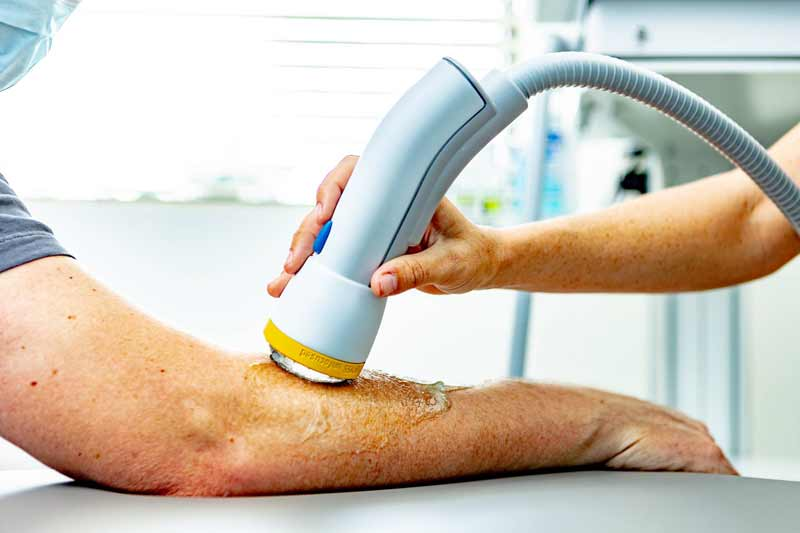
How SoftWave Heals Elbow Tendinopathy:
✅ Reduces pathological nerve fibers – studies show 40-60% reduction in abnormal nerve ingrowth within 4-6 weeks (Öhberg & Alfredson, 2004)
✅ Stimulates tenocyte activity – tendon cells start producing organized, functional collagen
✅ Improves blood flow to hypoxic tissue
✅ Reduces substance P and CGRP – breaking the chronic pain cycle
✅ Promotes proper collagen remodeling – transitioning from weak Type III to strong Type I collagen
✅ Breaks up scar tissue and adhesions at the tendon-bone interface
The research on this is incredibly strong. Multiple randomized controlled trials show 60-90% success rates for chronic tennis elbow and golfer’s elbow treated with shockwave – even in cases that failed other treatments. (Buchbinder et al., 2002; Haake et al., 2002; Spacca et al., 2005)
Patients report:
- Grip strength returning
- Ability to lift, carry, and work without pain
- Resolution of pain that’s been there for MONTHS or YEARS
- No more relying on braces or constant icing
5. Shoulder & Rotator Cuff Pain (Tendinopathy, Impingement, Bursitis, Partial Tears)
Shoulder pain is incredibly limiting. It affects:
- Sleep (can’t lie on it)
- Work (lifting, reaching)
- Exercise (overhead movements, pressing)
- Daily life (putting on a jacket, reaching for things)
And here’s the frustrating part: most shoulder pain is told it’s “not bad enough for surgery” – but it’s bad enough to significantly impact your life.
What’s really going on in chronic shoulder pain:
- Rotator cuff tendinopathy (supraspinatus, infraspinatus degeneration)
- Subacromial bursitis (inflammation between the rotator cuff and shoulder blade)
- Biceps tendinopathy (long head of biceps degeneration)
- Labral fraying (cartilage damage in the socket)
- Impingement (structures getting pinched with movement)
- Calcific deposits in tendons
- Nerve sensitization causing disproportionate pain
- Poor blood supply to degenerative tendons
Physical therapy helps some people. Injections provide temporary relief. But if the tissue biology isn’t capable of healing, those interventions stall.
How SoftWave Transforms Shoulder & Rotator Cuff Issues:
✅ Reduces rotator cuff tendon degeneration – activating tenocytes to remodel collagen properly
✅ Decreases subacromial inflammation – calming the bursitis component
✅ Breaks up calcific deposits – studies show shockwave can dissolve calcium in tendons (Gerdesmeyer et al., 2003)
✅ Improves blood flow to hypoxic rotator cuff tendons
✅ Calms hypersensitive nerve fibers – reducing disproportionate pain
✅ Stimulates healing in partial rotator cuff tears – research shows improved tendon thickness and structure on ultrasound (Kolk et al., 2013)
✅ Enhances scapular muscle function – improving stability and mechanics
Studies show 70-80% success rates for chronic shoulder pain treated with shockwave – with improvements in pain, function, and range of motion lasting 12+ months. (Hsu et al., 2008; Pan et al., 2003)
We’re seeing patients:
- Sleep through the night again
- Return to overhead activities (lifting, sports)
- Avoid surgery that was being recommended
- Regain strength and function they thought was gone
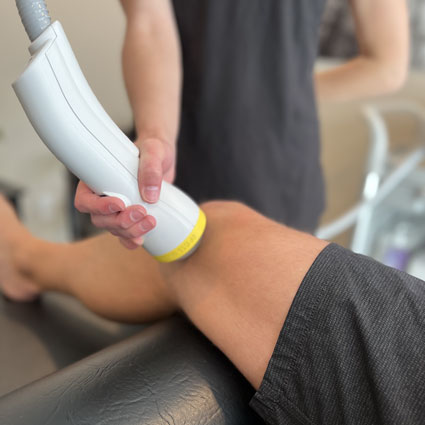
6. Knee Pain (Patellar Tendinopathy, IT Band Syndrome, Meniscus Issues, Patellofemoral Pain)
Knee pain is one of the most common complaints we treat – and it’s often multifactorial.
The knee takes a beating because:
- It’s a weight-bearing joint
- It’s influenced by the hip AND the ankle
- It has multiple pain generators (tendons, ligaments, cartilage, bursa, fat pads)
Common knee issues we see:
- Patellar tendinopathy (jumper’s knee)
- IT band syndrome (lateral knee pain)
- Meniscus degeneration (cartilage wear)
- Patellofemoral pain syndrome (pain behind the kneecap)
- Pes anserine bursitis (medial knee pain)
- Fat pad impingement (Hoffa’s syndrome)
- Chondromalacia patella (kneecap cartilage degeneration)
Most treatment focuses on strengthening and stretching. And those are important. But if the tissue itself is degenerative or inflamed, strengthening alone won’t fix it.
How SoftWave Addresses Knee Pain:
- Heals patellar tendinopathy – studies show shockwave significantly improves tendon structure and reduces pain in jumper’s knee (Vetrano et al., 2013)
- Releases IT band tension and trigger points – improving lateral knee mechanics
- Reduces inflammation in bursae (prepatellar, pes anserine)
- Improves blood flow to meniscus – supporting healing in degenerative tears
- Modulates pain from fat pad impingement – calming hypersensitive nerves
- Enhances cartilage cell metabolism – improving chondrocyte function in patellofemoral pain
- Breaks up scar tissue from old injuries or surgeries
We’re seeing patients:
- Return to running, jumping, squatting without pain
- Avoid knee surgery
- Regain quad strength (less inhibition from pain)
- Move better overall (improved gait mechanics)
7. Foot & Ankle Pain (Plantar Fasciitis, Achilles Tendinopathy, Morton’s Neuroma, Ankle Sprains)
Foot and ankle pain is incredibly disruptive. Every step hurts. Getting out of bed in the morning is miserable. Standing, walking, exercise – all compromised.
Common foot/ankle issues:
- Plantar fasciitis (heel and arch pain)
- Achilles tendinopathy (insertional or mid-portion)
- Morton’s neuroma (nerve pain between toes)
- Chronic ankle sprains (ligament instability)
- Posterior tibial tendinopathy (medial ankle pain)
- Peroneal tendinopathy (lateral ankle pain)
- Tarsal tunnel syndrome (nerve compression)
How SoftWave Heals Foot & Ankle Conditions:
For Plantar Fasciitis:
This is one of the most researched applications of shockwave therapy.
Plantar fasciitis isn’t really “inflammation.” It’s:
- Micro-tearing of the fascia at the heel attachment
- Degenerative collagen changes
- Nerve entrapment in the fascia
- Reduced blood flow at the insertion point
SoftWave:
- Breaks up adhesions and scar tissue in the fascia
- Reduces trapped nerve irritation
- Brings blood flow to an area that’s notoriously hypoxic
- Stimulates fibroblast activity to remodel collagen properly
- Reduces heel spur-related pain
Studies show 60-90% success rates for chronic plantar fasciitis with shockwave. (Gerdesmeyer et al., 2003; Rompe et al., 2007)
For Achilles Tendinopathy:
Achilles issues (both insertional and mid-portion) respond incredibly well to shockwave because:
- Reduces pathological nerve ingrowth
- Improves blood flow to the “watershed zone” (area with naturally poor circulation)
- Stimulates tendon cells to produce organized collagen
- Breaks up calcifications (in insertional tendinopathy)
For Morton’s Neuroma:
- Calms the inflamed, thickened nerve
- Reduces compression from surrounding tissue
- Improves microcirculation around the nerve
- Decreases pain without needing injections or surgery
For Chronic Ankle Sprains:
- Stimulates healing in overstretched ligaments
- Breaks up scar tissue limiting movement
- Improves proprioception and stability
- Reduces chronic inflammation
Patients report:
- No more morning heel pain
- Ability to walk, stand, and exercise again
- Reduced or eliminated need for orthotics
- Better ankle stability and confidence in movement
8. Carpal Tunnel & Hand Pain (CTS, Trigger Finger, Thumb Arthritis, DeQuervain’s Tenosynovitis)
Hand and wrist pain is incredibly limiting for daily life and work.
Common issues:
- Carpal tunnel syndrome (median nerve compression)
- Trigger finger (tendon sheath inflammation and catching)
- Thumb CMC arthritis (base of thumb joint degeneration)
- DeQuervain’s tenosynovitis (thumb side wrist tendon inflammation)
- Tendinopathy in wrist extensors/flexors
Traditional treatments usually involve:
- Bracing (which doesn’t fix the problem)
- Steroid injections (temporary relief, can weaken tissue)
- Surgery (with variable outcomes and recovery time)
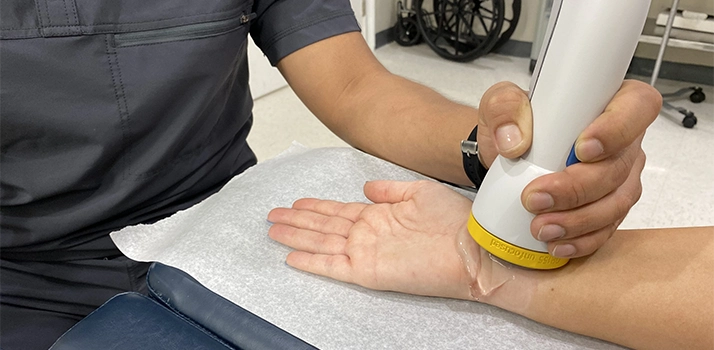
How SoftWave Addresses Hand & Wrist Conditions:
For Carpal Tunnel Syndrome:
CTS is caused by:
- Median nerve compression in the carpal tunnel
- Inflammation of the flexor tendon sheaths
- Fibrosis around the nerve
- Poor circulation to the nerve
SoftWave:
- Reduces inflammation in the carpal tunnel
- Improves blood flow to the compressed nerve
- Breaks up fibrotic tissue around the nerve
- Enhances nerve conduction velocity
- Reduces symptoms (numbness, tingling, pain)
Studies show shockwave can significantly improve carpal tunnel symptoms and nerve conduction studies – with many patients avoiding surgery. (Paoloni et al., 2015; Raissi et al., 2017)
For Trigger Finger:
- Reduces inflammation in the tendon sheath (A1 pulley)
- Breaks up nodules causing the “catching”
- Improves tendon gliding
- Reduces pain and restores normal finger motion
For Thumb CMC Arthritis:
- Improves joint circulation
- Reduces inflammation in the joint capsule
- Modulates hypersensitive pain nerves
- Improves function and grip strength
For DeQuervain’s Tenosynovitis:
- Reduces tendon sheath inflammation
- Improves blood flow to the tendons
- Releases adhesions restricting movement
- Reduces pain with thumb/wrist movement
Patients report:
- No more waking up with numb hands
- Improved grip strength
- Ability to work without constant wrist/hand pain
- Avoiding surgery
SPECIAL CASES: Beyond Specific Body Parts
9. Osteoarthritis & Degenerative Joint Disease (Any Joint)
“You just have arthritis. You’ll have to live with it.”
How many times have you heard that?
Here’s what most people don’t understand: Osteoarthritis isn’t just “bone-on-bone.” It’s a whole-joint disease involving:
- Loss of synovial fluid (joint lubrication)
- Cartilage breakdown and chondrocyte (cartilage cell) death
- Synovial inflammation (the joint lining becomes inflamed)
- Hypersensitized nerve fibers in the joint capsule
- Surrounding muscle weakness and atrophy
- Poor circulation to the joint space
- Osteophyte formation (bone spurs)
- Subchondral bone changes (the bone under the cartilage)
Most conventional treatments focus on ONE piece of the puzzle (pain meds, steroid injections, eventually surgery). But that doesn’t address the entire joint environment.
How SoftWave Addresses Osteoarthritis:
✅ Increases blood flow to the joint – bringing nutrients to cartilage (which has no direct blood supply)
✅ Reduces inflammatory molecules (IL-6, TNF-α, prostaglandins) in the synovial fluid
✅ Improves chondrocyte metabolism – cartilage cells become more active and produce better-quality cartilage matrix
✅ Modulates hypersensitive nerve endings in the joint capsule – reducing disproportionate pain
✅ Breaks up calcifications and fibrotic changes around the joint
✅ Stimulates synovial fluid production – improving lubrication
✅ Supports bone remodeling – healthier subchondral bone
Studies show 50-70% improvement in pain and function for knee OA patients treated with shockwave – comparable to or BETTER than steroid injections, but with tissue-regenerating effects instead of tissue-degrading ones. (Zhao et al., 2012; Lee et al., 2013)
Similar results are seen for hip OA, shoulder OA, hand OA, and ankle OA.
Patients report:
- Better mobility and less morning stiffness
- Significantly reduced pain
- Ability to return to activities they’d given up
- Improved quality of life
- Many avoiding or delaying joint replacement surgery
10. Non-Healing Wounds, Diabetic Ulcers & Tissue Regeneration
This is one of SoftWave’s FDA-cleared indications – and the research here is absolutely fascinating.
Chronic wounds fail to heal because of:
- Poor blood supply (especially in diabetics with peripheral vascular disease)
- Chronic, unresolved inflammation that damages tissue faster than it can repair
- Cellular exhaustion (senescent cells that have “given up”)
- Biofilm formation (bacterial colonies that block healing)
- Impaired growth factor signaling
- Lack of stem cell recruitment
Traditional wound care focuses on cleaning, debridement, and dressings. But if the biological environment isn’t capable of healing, those interventions stall.
How SoftWave Changes Wound Healing:
✅ Massive angiogenesis – Studies show 300%+ increases in capillary density around treated wounds (Schaden et al., 2007)
✅ Promotes healthy granulation tissue – the “scaffold” for new skin
✅ Improves oxygenation in hypoxic tissue
✅ Activates local stem cells and growth factors (VEGF, PDGF, FGF, TGF-β)
✅ Reduces bacterial load – shockwave disrupts biofilms
✅ Enhances epithelialization – faster skin closure
✅ Reduces excessive inflammation – allowing the healing process to proceed
For people dealing with wounds that won’t close for MONTHS (or even years), this can literally save limbs and lives.
We’re also seeing incredible results with:
- Post-surgical wounds that won’t heal
- Radiation-induced tissue damage
- Burn healing (SoftWave is used in burn centers worldwide)
- Pressure ulcers
- Venous stasis ulcers
Why I’m All-In on SoftWave
Look – I’ve always been committed to helping people heal at the root cause level. That’s why chiropractic care, nervous system optimization, functional nutrition, and lifestyle changes are the foundation of everything we do here.
But when I dove into the RESEARCH behind SoftWave…
When I saw the mechanisms of action…
When I started experiencing the results with our own patients…
I knew this was the missing piece for so many people who’d been stuck.
Because here’s the reality: sometimes the body WANTS to heal, but something is blocking that signal.
Maybe it’s:
- Poor circulation to an area (hypoxia)
- Chronic nerve irritation keeping pain cycles active
- Disorganized scar tissue preventing proper movement
- Inflammatory chemicals that won’t clear
- Stem cells not being recruited
- Growth factors that aren’t being activated
SoftWave provides the biological trigger to GET PAST the block.
It’s not doing the healing FOR you. It’s removing the interference so your body can finally do what it was designed to do.
And when you combine it with:
- Proper spinal alignment ✅
- Optimal nervous system function ✅
- Good nutrition ✅
- Healthy lifestyle habits ✅
- Strategic movement and rehab ✅
That’s when real transformation happens.
If Your Condition Hasn’t Healed… There’s a Reason
I hear this ALL THE TIME in practice:
“Dr. Justin, I’ve tried everything – physical therapy, stretching, injections, medications, even surgery – but nothing has worked.”
In most cases, the problem wasn’t that those treatments are “bad.”
The problem was they weren’t addressing the biological environment that was preventing healing.
- PT can’t create new blood vessels.
- Stretching can’t remodel degenerative collagen.
- Injections can’t recruit stem cells (and steroids actively BLOCK regeneration).
- Medications can’t turn on angiogenesis.
SoftWave can.
It changes the tissue environment. It turns on healing pathways. It brings blood flow. It calms nerve inflammation. It recruits stem cells. It signals tissue to remodel properly.
Your body WANTS to heal. It just needs the right support.
Ready to See What Your Body Is Capable Of?
If you’re local to Minnetonka, Hopkins, or anywhere in the Twin Cities area and you’re dealing with:
✅ Low back, hip, or SI joint pain
✅ Neck, trap, or upper back tension
✅ TMJ dysfunction
✅ Tennis or golfer’s elbow
✅ Shoulder or rotator cuff issues
✅ Knee pain (tendinopathy, meniscus, arthritis)
✅ Plantar fasciitis, Achilles pain, or foot/ankle problems
✅ Carpal tunnel, trigger finger, or hand pain
✅ Osteoarthritis in ANY joint
✅ Non-healing wounds or chronic injuries
I’d love to see if SoftWave can help you finally move forward.
📅 Schedule your initial SoftWave evaluation:
https://calendly.com/drjustinlee/softwave-scheduling
📲 Text or call me directly:
(612) 470-9210
🌐 Learn more:
drjustinlee.com
Because you’re not broken.
You just need the right signal.
– Dr. Justin Lee, D.C.
Minnetonka Family Chiropractic
Minnetonka, MN
Key References:
- Wang CJ, et al. (2003). Shock wave therapy induces neovascularization. J Orthop Res.
- Mariotto S, et al. (2009). ESWT in inflammatory diseases: molecular mechanisms. Curr Med Chem.
- Notarnicola A, et al. (2012). Biological effects of ESWT on tendon tissue. Muscles Ligaments Tendons J.
- Hausdorf J, et al. (2008). Molecular basis of ESWT in tendon disorders. Int J Surg.
- Takahashi N, et al. (2007). Effect of ESWT on callus formation during bone lengthening. J Orthop Sci.
- d’Agostino MC, et al. (2015). Shock wave as biological therapeutic tool. Biomed Res Int.
- Császár NB, et al. (2015). Radial shock wave devices generate cavitation. PLoS One.
- Ohtori S, et al. (2011). Shockwave application to rat skin induces degeneration and reinnervation of sensory nerve fibers. Neurosci Lett.
- Farr D, et al. (2014). Extracorporeal shockwave therapy in calcific tendinitis of the shoulder. Acta Orthop Belg.
- Kim YW, et al. (2015). Effect of radial extracorporeal shock wave therapy on pain and function in patients with chronic neck pain. Ann Rehabil Med.
- Al-Moraissi EA, et al. (2020). Needling therapies in the management of myofascial pain of the masticatory muscles: A network meta-analysis. J Oral Facial Pain Headache.
- Buchbinder R, et al. (2002). Shock wave therapy for lateral elbow pain. Cochrane Database Syst Rev.
- Haake M, et al. (2002). Extracorporeal shock wave therapy for tennis elbow: randomised controlled multicentre trial. BMJ.
- Spacca G, et al. (2005). Radial shock wave therapy for lateral epicondylitis: a prospective randomised controlled study. Eura Medicophys.
- Gerdesmeyer L, et al. (2003). ESWT for the treatment of chronic calcifying tendinitis of the rotator cuff. JAMA.
- Kolk A, et al. (2013). Radial extracorporeal shock wave therapy in patients with chronic rotator cuff tendinitis. Bone Joint J.
- Hsu CJ, et al. (2008). Extracorporeal shockwave therapy for calcifying tendinitis of the shoulder. J Shoulder Elbow Surg.
- Pan PJ, et al. (2003). Extracorporeal shock wave treatment for chronic calcific tendinitis of the shoulders. Kaohsiung J Med Sci.
- Vetrano M, et al. (2013). Platelet-rich plasma versus focused shock waves in the treatment of jumper’s knee in athletes. Am J Sports Med.
- Rompe JD, et al. (2007). Shock wave therapy for chronic plantar fasciopathy. BMJ.
- Paoloni M, et al. (2015). Extracorporeal shock wave therapy and ultrasound therapy improve functional performance of arm in breast cancer survivors. Eur J Phys Rehabil Med.
- Raissi GR, et al. (2017). The effectiveness of radial extracorporeal shock waves for treatment of carpal tunnel syndrome: A randomized clinical trial. Ultrasound Med Biol.
- Zhao Z, et al. (2012). ESWT reduces progression of knee OA in rabbits. J Orthop Res.
- Lee SY, et al. (2013). Extracorporeal shockwave therapy for patients with knee osteoarthritis. Bone Joint J.
- Schaden W, et al. (2007). Extracorporeal shock wave therapy for chronic soft tissue wounds. Wound Repair Regen.
Dr. Justin Lee, D.C.
Doctor of Chiropractic & Holistic Health
Dr. Justin Lee is a passionate chiropractor who believes in the innate healing potential within you. This passion stems from a personal experience in collegiate hockey, competitive CrossFit, and a relentless pursuit to holistically optimize performance and recovery. His professional mission is to help as many individuals and families as possible uncover the path to true health. He is dedicated to guiding them on how to integrate lifestyle changes for a sustainable and healthier future. All of which shapes his unique approach to personalized chiropractic care.
You are one ‘aJUSTINment’ away from a healthier life.

get to know me

